
Is it possible for us to know Allah?

Know that Allah is not just a name. Allah exists... He is not non-existent... so surely there is a knowledge for knowing Him. But it must be remembered here that knowing Allah does not mean that we can see Allah in some particular form or shape. No... that is not what it means.
Before we talk about whether or not we can know Allah, it is best to first ask ourselves: why do we need to know Allah?
There are many important reasons why we must know Allah. This time, let us explain just two examples. The first is so that we can obey the prohibition in the Quran, Surah Yasin, verse 60, which says: "O children of Adam, do not worship satan."
At first glance, Surah Yasin verse 60 seems unremarkable, and its content is very clear: a prohibition against worshipping satan. But... if we think about it carefully, can we be sure that we are not worshipping satan, when satan is unseen and Allah is unseen too? If the verse forbade us to worship statues... well, that we could do. Or if the prohibition were like the one in Surah An-Nur, verse 21: "O you who believe, do not follow the ways of satan," this we could avoid, because we already know the traits of satan, such as arrogance, envy, jealousy, greed, and so on. But when the verse says, "O children of Adam, do not worship satan," this proves that we must first know Allah, so that we can tell the unseen nature of Allah apart from the unseen nature of satan.
The second reason we must know Allah is so that we can return to Allah at the moment of death (sakaratul maut). Know that when we die, we must follow what is written on the funeral bier: innalillahi wa inna ilaihi raji'un, "from Allah I came and to Allah I return." But how could we possibly return to Allah if we do not know Allah? How could we return to something we do not know? Know that at the moment of death, all kinds of beings will come to lead us astray. A dying person is usually visited by their deceased grandmother, or their deceased parents, or even by figures in white robes, black robes, and so on. If he follows any one of these, he dies in su'ul khatimah, a bad ending, or in misguidance. Why misguidance? Because he should have died returning to Allah, but in reality he returned to this one and that one, not to Allah.
Once we know that we must know Allah, then we can move on to the question: "Is it possible to know Allah?" Allah is unseen, in other words invisible, so how can we know Him?
The story of Prophet Abraham searching for his Lord in Surah Al-An'am, verses 76 to 80, is clear proof that we can surely know Allah. If Abraham was searching for a Lord, that means that at first Abraham did not yet know Allah either. At first he thought that the stars, the moon, or the sun was God. After trying for quite a long time and continuing to pray, begging from the deepest part of his heart, Abraham was finally given guidance by the Lord of the universe, Allah. From then on, Abraham knew the true Lord, Allah. How do we know that at the end of his search Abraham had come to know Allah? It is written clearly in verse 80 of Surah Al-An'am, where Abraham was able to turn to Allah, saying "inni wajjahtu wajhiya...", "I turn my face to the One who created the heavens and the earth," that is, Allah. So this is the proof that Abraham had come to know Allah: in the end, he was able to face Allah, inni wajjahtu wajhiya. Now, this verse, "inni wajjahtu wajhiya," is also what we recite every time we pray. The difference is that Abraham uttered "inni wajjahtu wajhiya..." after he had come to know Allah, so he truly knew how to face Allah, while most of us say "I turn my face to Allah" even though we do not yet know Allah.
So, Abraham proved that human beings can know Allah. And from then on, Abraham has been called the father of TAWHID. Therefore, the knowledge that enables us to know Allah is the KNOWLEDGE OF TAWHID.
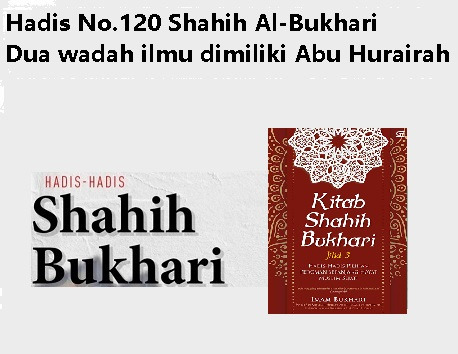
As the saying goes, where there is a will, there is a way. Everything will succeed if it is done with the appropriate knowledge. So which knowledge can introduce us to Allah? It is the knowledge of Prophet Muhammad, because Prophet Muhammad was the first person to introduce Allah to the Muslim community. But remember, the religious knowledge that Prophet Muhammad brought is of two kinds, as stated by Abu Hurairah in the authentic hadith in Sahih Bukhari, number 120, in which Abu Hurairah admitted that he had learned two kinds of knowledge from Prophet Muhammad.
People have given all sorts of interpretations of what the two kinds of knowledge in the hadith narrated by Abu Hurairah mean. In fact, the first is the knowledge of shariah, and the second is the knowledge of inner matters, which is called the knowledge of haqiqah. So, if we want to know Allah, we must study the knowledge of haqiqah, which is the knowledge of tawhid. That is why people who only have knowledge of shariah will surely be unable to accept that we can actually know Allah, because they look at it only through the lens of shariah. This is exactly what we are striving for at this time: we are trying our utmost to open the minds of the people of shariah, by nudging their thinking with a few haqiqah questions. For example, by asking, "When we pray inside the Kaaba, which direction do we face?" We hope that among the people of shariah, some will be moved to think that the person praying is, in reality, not facing the Kaaba, but facing Allah. But this task is truly challenging, because many people will condemn us, accuse us of making religion difficult, and even accuse us of being astray. Yet this only becomes stronger proof that today, more than 90% of Muslims may have only knowledge of shariah, without any knowledge of haqiqah.
Click and read the related articles:
What is the knowledge of haqiqah?
Religious knowledge has 2 parts
Why can't the knowledge of haqiqah be learned online?
Note:
We do not give lessons in the knowledge of tawhid over the internet. The religious articles on this website are not lessons in tawhid; they are only meant to remind those who read them of the importance of knowing tawhid. And studying tawhid must be done through face-to-face study sessions. So once again, we remind you that this website, islamdanquran.com, is not a place to study tawhid.
Related Stories
islamdanquran © 2026
To learn the true and correct knowledge of shariah and hakikat, contact us in the CONTACT section.
We care about your data in our privacy policy.