
What is Islamic Tawhid knowledge?
-->
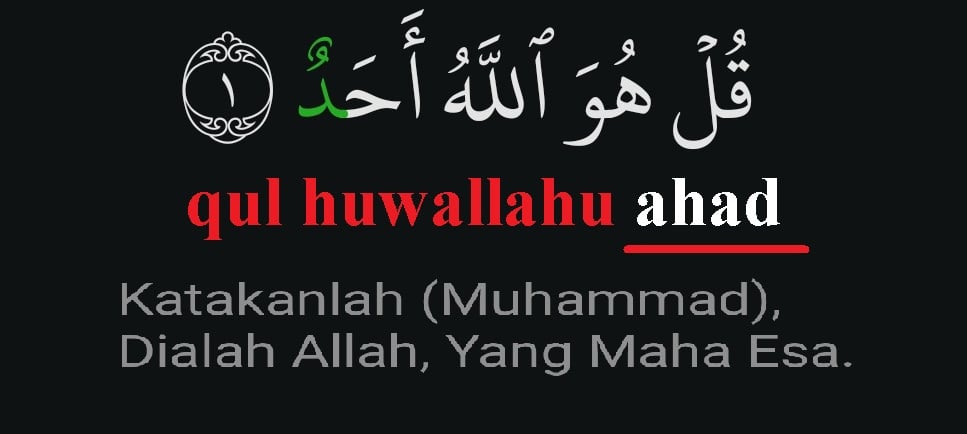

Before we begin explaining this, we want to tell you the main reason we created this website. From more than 60 years of experience teaching the knowledge of Tawhid in many places across Indonesia, Malaysia, and Singapore, we have found that 99% of the Tawhid classes we have come across only teach their students to recite the phrase of Tawhid (La ilaha illallah) thousands of times. They do not show how to actually carry out the command of that phrase.
Qul huwallahu ahad (Say: "He is Allah, the One.")
The word "Tawhid" comes from the word ahad, which means "One." So the knowledge of Tawhid is the knowledge of how to affirm the oneness of Allah in prayer. Therefore, if we do not know how to affirm Allah's oneness, then we are certainly always making Allah "two," which is an unforgivable sin. (One is the opposite of two, three, and so on.)
Because of the great importance of Tawhid, the knowledge of affirming Allah's oneness, Allah assigned all the prophets and messengers to convey it. This is found in the Qur'an, Surah Al-Anbiya, verse 25, which means: Allah did not send any messenger except to convey Tawhid, namely La ilaha illallah.
So the knowledge of Tawhid is about learning how to carry out the phrase of Tawhid, La ilaha illallah. This is the fatal mistake of most Muslims today: they treat the phrase of Tawhid as something to be merely recited thousands of times, yet they do not know, and have never once carried out, what that phrase commands.
We must put into practice what the phrase of Tawhid says, namely "There is no god but Allah." That way, when we pray, we truly worship the One who is named Allah, and we do not associate any partners with Him. This is what it means to affirm the oneness of Allah.
This is the most important knowledge that every Muslim who is of sound mind and has reached puberty must learn. Tawhid gives true knowledge of Allah. A person who has never studied Tawhid knows Allah only by name.
This knowledge is not new. In fact, it was the very first thing our Prophet taught. Prophet Muhammad received his first revelation in the Cave of Hira around 610 CE, while the command to pray came around 621 CE. That means for about 11 years the Prophet taught Tawhid, first introducing people to who Allah is, and only then were they commanded to worship Allah (through prayer). That is why the prayer and faith of people in the past were far stronger than the faith of people today, who lack the foundation of religion, which is Tawhid. This can be seen in how lightly, and how fearlessly, Muslims today delay prayer or even abandon it. The root of all these problems is that their faith is merely inherited, not faith grounded in knowledge of Tawhid (see Q.S. 58:11).
Their knowledge of Allah goes no further than this: that Allah created the heavens and the earth, or that Allah provides sustenance. But know that followers of other religions also acknowledge that their gods created the heavens and the earth, provide them with sustenance, and so on. So that kind of knowledge is not enough for us to truly know Allah, or to truly be certain of Him and believe in Him. And in the Qur'an, Surah Al-Mujadalah, verse 11, it is clearly stated: "Allah raises in rank those who believe and those who have knowledge."
In short, in the knowledge of Tawhid we learn the pillars of faith and the pillars of Islam, in a way suited to adults. In studying the first pillar of faith, "belief in Allah," we learn to know Allah in the same way the Prophet Muhammad introduced Him to the people of old. All the explanations, and the questions and answers between the people and the Prophet in the course of introducing Allah, are recorded in the Qur'an, which contains more than 6,000 verses. But it must be remembered that some of the verses describing Allah are mutashabihat (allegorical or ambiguous). So, to avoid misinterpretation, and to avoid guessing at the meaning of those verses, the teacher of Tawhid must be someone who has truly received guidance from Allah.
Here is some evidence showing how important the knowledge of Tawhid is:
The declaration of faith (shahada), the requirement for entering Islam, contains the phrase of Tawhid.
People who are near death are often told to recite the phrase of Tawhid.
The main duty of all prophets and messengers was to convey Tawhid (see Surah Al-Anbiya, verse 25).
The first pillar of Islam contains the phrase of Tawhid (La ilaha illallah).
Given all this evidence and these facts about the importance of Tawhid, have you studied Tawhid yet? And what reason is still holding you back from learning it?
But once again, we remind you: this is not about reciting the phrase of Tawhid. It is about how to put into practice the command of that phrase. Most of the Tawhid or hakikat (inner spiritual knowledge) classes today only recite the phrase of Tawhid, without knowing how to carry out its command, which is to affirm the oneness of Allah in prayer.
This knowledge of Tawhid is the very form of hakikat that our Prophet taught. It is not like the way people study hakikat today under the names of this or that tariqah (Sufi order). Moreover, most of what is called hakikat today is closer to the supernatural than to religious knowledge. This is why many people view hakikat negatively. As a result, many young people today are afraid to study it, and worse, some have begun to dare to say that this Tawhid teaching is made up, and some even accuse it of being deviant.
To explain more clearly: if you would like to hear directly (in a mudzakarah, or discussion session) a simple introduction to this Tawhid knowledge (you do not have to join our classes), please come and meet us in cities across Indonesia and Malaysia, such as Jakarta, Depok, Surabaya, Samarinda, Balikpapan, Padang, Pekanbaru, Duri, Sorek, Bengkalis, Batam, Lampung, Makassar, Kuala Lumpur, Perak, Selangor, Kota Kinabalu, and Singapore.
Please write your WhatsApp number and your home city in the CONTACT section. God willing, this is purely religious outreach, with no commercial element and no payment of any kind. However, we ask that this be only for those who are serious. If you only want to read, then please just read here. Nearly 5,000 people have sent us their phone numbers, but when our teacher arrived in their area and we contacted them, they simply stayed silent. We do not lose anything, but it would be better for us to schedule our teacher's visit to another area, where people are truly interested in listening.
Please read the comments and opinions of community leaders and religious leaders about Tawhid classes on islamdanquran. Scroll all the way to the bottom.
Click and read the related articles below:
Where can I study hakikat?
Are there really people today who receive guidance from Allah?
Our message
The right way to study hakikat
Why can't hakikat be studied online?
Sample photos of a Tawhid class
Note:
We do not teach Tawhid through the internet. All the religious articles on this website exist only to demonstrate and remind people of how important the knowledge of Tawhid is. Studying Tawhid is like any ordinary religious class, such as those held in a prayer room (musholla) or a study circle (majlis ta'lim).


"While searching for hakikat teachings in many places, I always felt something was wrong, because most of them leaned toward mysticism or the supernatural. Alhamdulillah, I finally came across islamdanquran, where I found answers to all my doubts about religion. Now I feel truly fulfilled and confident in my worship."
- Teguh Mawardi, Advokat
Surabaya






"Alhamdulillah, in my later years, Allah led me to the Tawhid classes taught by the ustadz at islamdanquran. Only now do I fully understand acts like takbiratul ihram and the mi'raj prayer. Most importantly, I learned the practice of Tawhid: affirming the oneness of Allah, as the Prophet taught."
- Andi Jaya Sose, Pengusaha & Tokoh Masyarakat
Makassar
"I used to be completely against spiritual knowledge, because I had seen friends who studied Sufi orders. But after studying at islamdanquran, I became certain that the Prophet taught inner knowledge, which is Tawhid. Without it, all our worship would feel like mere ritual."
- Ewasoska, Pejabat Publik
Padang Panjang (Sumbar)
"I had joined many different study groups, but something always felt missing in my worship, especially my prayer. Alhamdulillah, by Allah's will, I found islamdanquran, which taught me the true practice of Tawhid. Now I feel fully satisfied and steady in all my worship, especially my prayer."
- Nofri Haryadi, Entrepreneur Kuliner
Pekanbaru


"I graduated from a well-known Islamic boarding school in Java. I am a Qari and a teacher who gives religious talks every day. But after studying at islamdanquran, I am convinced that this is the true and correct teaching of Tawhid, just as the Prophet taught it. Now I finally understand how the Prophet was able to convince people to embrace Islam."
- Im Son Hadi, Pemuka Agama
Lampung


"I attended many religious classes, but none of them felt special. Then I studied at islamdanquran, and I suddenly wanted to tell my family and friends about it. Only here did I find truly satisfying answers to the religious questions that had been a mystery to me for so long."
- Mulyadi, Pengusaha Tanah Abang
Jakarta


Since my teens, I have loved studying all kinds of Islamic teachings, both outward and inner, and for decades I have taught inner spiritual knowledge. When I attended the Tawhid classes at islamdanquran, it felt like waking up from a dream. I discovered knowledge that truly shows how to affirm the oneness of Allah as the Prophet taught, not based on mere opinions, but on the Qur'an and Hadith."
- Bobby Chandra, Guru Tarikat Hakikat
Jakarta


"I am endlessly thankful that Allah led me to the Tawhid classes at islamdanquran. Only here did I find teaching that practices the whole of Islam, both outward and inner. Before, some classes were strong only in outward practice, and others only in inner knowledge. Here, I feel I have found Islam as the Prophet truly practiced it, in both."
- Mukolip, Weldworks Owner
Samarinda
islamdanquran © 2026
To learn the true and correct knowledge of shariah and hakikat, contact us in the CONTACT section.
We care about your data in our privacy policy.